THE SAHARA DESERT IN MOROCCO – ESSENTIAL INFORMATION & NOMAD INSIGHTS
🇫🇷 Cette page est également disponible en français — Guide Sahara marocain
Welcome to your complete Moroccan Sahara guide. No generic content here — just the real experience of Lahsan and his team, born in this desert, sharing what they truly know.
From M’Hamid El Ghizlane to the great dunes of Erg Chegaga, from nocturnal wildlife to singing dunes — everything you need to prepare your Moroccan Sahara trip, live an authentic experience, and understand this living desert like no other.
📌 In this guide: Packing tips · Choosing your destination · Wildlife & flora · Singing dunes · Water in the desert · Nomadic life · Weather · FAQ
Preparing Your Moroccan Sahara Trip
What to Pack for a Morocco Desert Trek
Preparing for the Moroccan Sahara requires balance — not too much, not too little. The camels carry the heavy equipment. You walk light, mind free.
The essentials for a Morocco desert trek: well broken-in walking shoes, light cotton or linen clothing for the day, warm layers for cool nights — the desert temperature drops fast when the sun disappears. Full sun protection (hat, sunglasses, high-SPF sunscreen), light scarf against wind and sand, water bottle of at least 2 litres, headlamp with spare batteries, warm sleeping bag, camera.
→ Complete packing list — what to prepare for the Moroccan desert
How to Get to M’Hamid El Ghizlane
M’Hamid El Ghizlane is the last town before the great desert — and that journey is already the beginning of the adventure. First tip from this Moroccan Sahara guide: arrive the evening before if possible. The village atmosphere at sunset is worth it.
From Marrakech: CTM/Supratours bus (~€15-25) or private taxi (~€150-250) — approximately 6-7 hours. From Ouarzazate: 3-4 hours. From Zagora: 1.5 hours — the closest option.
For groups of 6 or more, ADN Sahara can organise the transfer — contact Lahsan directly.
When to Visit the Sahara Desert Morocco — Weather Month by Month
The Moroccan Sahara is alive year-round — but not all seasons are equal.
October – November — the ideal season. Golden light, perfect temperatures (20-25°C by day, 10-15°C at night), fewer crowds. The best time for your Morocco desert trip.
December – February — pleasant days (15-20°C), very cold nights (0-5°C). Bring warm equipment. The reward: a crystal-clear sky and stars of breathtaking clarity.
March – April — mild temperatures, vegetation greening up after winter rains. Excellent period.
May – September — intense heat (30-45°C). Very early morning departures recommended for treks. By air-conditioned 4×4: possible and comfortable.
→ Sahara weather guide — temperatures month by month
Choosing Your Moroccan Sahara Destination
Erg Chigaga vs Erg Chebbi — The Honest Comparison
This is the question everyone asks when preparing their Moroccan Sahara trip. Here is the honest answer — no bias.
Erg Chegaga — also called Chigaga or Chgaga by the nomads — stretches 40 km long and 15 km wide, accessible from M’Hamid El Ghizlane. Wild, preserved, far from tourist crowds. To get there on foot, you walk three days — and that is precisely why it remains intact. ⭐⭐⭐⭐⭐ Very wild.
Erg Chebbi — near Merzouga, 22 km long and 5 km wide. Easy access, developed infrastructure, more touristy atmosphere. Ideal for a quick first encounter with the desert or for travellers who prefer comfort. ⭐⭐⭐ More touristy.
In short: if you seek authenticity and solitude — Erg Chegaga. If you prefer easy access and comfort — Erg Chebbi. Both are beautiful. Simply two different ways of loving the desert.
→ Full comparison: Erg Chigaga vs Erg Chebbi
The Landscapes of the Moroccan Sahara — Reg, Erg, Hamada
The Moroccan Sahara is not just dunes. Here are the three main landscape types you will cross:
The erg — the ocean of sand dunes, shaped and reshaped by the wind constantly. Erg Chegaga and Erg Zahar are among the most beautiful and least visited in Morocco.
The reg — a vast flat desert plain, covered with pebbles and black stones polished by time. Lunar scenery, absolute silence, infinite horizon. Most camel caravan routes crossed the regs.
The hamada — rocky plateau, arid and windswept. Raw mineral beauty, often crossed at the start of a trek from M’Hamid.
Each landscape has its own character, light, and silence. On a 6-day trek, you cross all three.
Treks and Circuits in the Moroccan Sahara
On Foot or by Camel — the Authentic Nomadic Experience
Walking in the desert means entering it — not crossing it. The slow caravan pace, mint tea breaks in tamarisk shade, sand underfoot. That is how nomads have always travelled — and how this Moroccan Sahara guide recommends you discover it with ADN Sahara.
All our treks alternate walking and camel riding — at your pace, as you wish. No performance required. Just presence.
By 4×4 — Comfort and Wide Open Spaces
To cover greater distances while keeping comfort. Ideal for families with young children, seniors, or those who want to explore the Moroccan desert without the physical effort of walking. Same landscapes, same authenticity — a different way to experience them.
Choosing the Duration of Your Sahara Morocco Trek
1 day — first encounter with the desert. Perfect for an initiation or those short on time.
2 days / 1 night — a night under the stars. The two most beautiful moments of the Sahara: sunset and golden dawn.
6 days Erg Chegaga — the ancient caravan route. 70 km, easy level. Legendary dunes and Oum Laâlag oasis.
6 days Erg Zahar — the wild crossing. 100 km, moderate level. Kasbah Bousnina, singing dunes, Al-Dhweib oasis.
Tailor-made — from 1 day to 1 month and more. Lahsan builds your itinerary from your wishes.
→ See all our Moroccan Sahara treks → See all our Sahara 4×4 circuits
Desert Wildlife Morocco — Hidden Life in the Dunes
The desert is not silent. It teems with life — for those who know how to look. One of the most beautiful surprises this Moroccan Sahara guide can offer you.
Animals of the Moroccan Sahara Desert
Every morning, the sand reveals its silent diary. Tracks and footprints left during the cool night. Lahsan has been teaching people to read them since childhood.
The jerboa — this small rodent that hops like a mini-kangaroo leaves a delicate star-shaped line in the sand. Spotting a jerboa at dusk is a moment of rare grace.
The fennec fox — miniature fox with oversized ears, the living treasure of the Sahara. Shy, nocturnal, it rarely shows itself. Sometimes, at sunrise or sunset, it offers you its fleeting silhouette. Magical. Unforgettable.
The desert hare — fast, discreet, magnificently adapted. Its larger prints with marked claws betray its nocturnal wanderings.
The desert hedgehog — taller on its legs than its European cousins, with large ears. Its characteristic tracks dot the sand each morning.
The skink — also called “sand fish”, it undulates through sand like water. Fascinating to watch as it surfaces then plunges back.
Agama lizards sunbathe on already-warm stones in the morning. Beetles leave delicate little prints as they walk. Migratory birds cross the sky in season: larks, wheatears, sometimes majestic raptors.
Sometimes on the horizon — wild donkeys, free and proud, or rarer still, wild camels.
Desert Star — Identity Card
Name: Cataglyphis bombycina Nickname: The Saharan silver ant — “la fulgurante” — fastest ant in the world First described: 1859, by naturalist Roger Habitat: sand dunes of North Africa — from Morocco to the Arabian Peninsula Size: approximately 1 cm — don’t let appearances fool you Colour: silver — its triangular hairs reflect light at 98% Speed: 85.5 cm/s — 47 steps per second Active when: sand reaches 45-50°C — when everyone else hides Diet: heat-killed insects only — strict scavenger. Your vegetable peelings? It won’t give them a second glance. Water needs: yes — offer it a few drops in a hollow and it will come to drink. A spectacle very few travellers have had the chance to witness. Does it bite? No — worker ants have no reason to bother you Special feature: never gets lost — navigates by the sun like a natural GPS. Its legs touch the ground for just 7 milliseconds per step.
On the trail, it looks like it isn’t walking — it’s flying horizontally. Did you see it? You’re not alone.
→ Source: Journal of Experimental Biology — University of Ulm
Scorpions and Snakes in the Moroccan Sahara — What You Need to Know
They exist — and Lahsan will tell you frankly. In the cool season (October-April), low temperatures keep them inactive and discreet. One simple reflex: shake your shoes every morning. A nomadic habit that becomes second nature in a day.
Desert Flora Morocco — Extraordinary Survivors
The desert is not an empty sea of sand. It is a fragile ecosystem full of plants that have defied drought for millennia.
Colocynth (citrullus colocynthis) — grows discreetly, bitter and toxic in its flesh. Yet gazelles feed on it happily.
Sodom’s apple (Calotropis procera) — strange shrubs with thick leaves, fascinating to observe. Though toxic, they are an integral part of the desert landscape.
Tamarisks — survive on almost nothing, offering their precious shade to caravans. On the trail, they often signal underground water nearby.
Acacias — talh for the nomads — dot the oueds with their generous silhouette. Their shade is precious, their presence soothing.
Date palms — appear near oases, their presence always signalling accessible underground water.
This list is just a glimpse — the Moroccan desert hosts far more plant species than one might imagine. Some are found only in very specific areas, known only to Lahsan. The best way to discover them? Come and see for yourself. 🌿
Singing Dunes of the Moroccan Sahara — The Voice of the Ancestors
As far back as the 13th century, Marco Polo described this phenomenon in his travel journals. Today science explains it — but takes none of its mystery away. An unmissable entry in any Moroccan Sahara guide.
What Are Singing Dunes?
The dune song begins when your footsteps make sand slide down the slope. The grains — rounded, coated with a particular mineral varnish called “desert glaze” — move in perfect synchronisation. Millions of grains creating a coherent, deep, powerful sound wave.
CNRS researchers have measured up to 110 decibels at the surface — the intensity of a symphony orchestra. For the Berber nomads of the Moroccan Sahara, it is the voice of the ancestors. For physics, it is granular resonance. For you — it is a sound you will hear nowhere else.
Where to Hear Singing Dunes in Morocco?
Erg Zahar, accessible only on foot from M’Hamid El Ghizlane, is one of the most remarkable sites for this phenomenon in Morocco. Inaccessible by vehicle — which is precisely why it remains preserved and authentic.
→ Scientific source: CNRS / National Museum of Natural History — The song of the dunes (source in French)
→ 6-Day Erg Zahar Trek — hear the singing dunes
Water in the Moroccan Desert — The Nomads’ Ancient Secret
The Drâa — The River That Sleeps Under the Moroccan Desert
The Drâa is the longest river in Morocco — 1,100 kilometres from the Atlas to the gates of the Sahara. Its vast palm grove stretches from Agdz to M’Hamid, carrying within it the history of human settlement on the Saharan margins.
But from M’Hamid, the river sleeps. Its bed is dry. The Drâa’s waters are seasonal, heavily dependent on rain and snow from the southern Atlas slopes — and largely underground.
Invisible Water — How Nomads Find It
Yet the water is there. Invisible, but present. Palm trees growing along the dry riverbed signal it silently — their roots reach the deep aquifers that the human eye cannot see.
For centuries, nomads have developed khettaras — underground drainage galleries dug at a gentle slope, capturing water tables and bringing them to the surface without pump or motor. A millennial hydraulic genius, entirely natural, still in use in M’Hamid.
Lahsan has been reading these signs since childhood. He knows where the hidden wells are, where water sleeps under the reg. This knowledge — passed from father to son for generations — is one of the most precious things he shares with you on the trek.
→ Source: CNES — La vallée du Drâa, un espace en profondes mutations (source in French)
Nomadic Life in the Moroccan Sahara — Traditions and Hospitality
Who Are the Nomads of the Moroccan Desert?
For millennia, life in the Moroccan Sahara has organised around a single law: move to survive. The scarcity of water, the aridity of soils, the unpredictable seasons — all have shaped a nomadic culture of extraordinary richness and resilience.
Around M’Hamid El Ghizlane and the Drâa Valley, several communities have coexisted for centuries. The Sahraouis, Arabic-speaking and hassanya-speaking, raise camels, goats and sheep and move in search of pastures in their traditional black tents woven from goat and camel hair. The Aït Atta, a semi-nomadic Berber tribal confederation, long dominated the territory between the Saghro massif and the Drâa Valley. The Chleuhs, Berber-speaking in tachelhit, sometimes descend to the gates of the desert from the Anti-Atlas and the Souss.
Different languages, different histories — but the same fundamental values: solidarity, hospitality, respect for the desert. Hospitality is not politeness here — it is a sacred value. In the desert, you share what you have with whoever passes. Always.
All ADN Sahara guides are sons and grandsons of nomads — born here, not trained for tourism. Lahsan himself takes over from his father when he returns to the village to rest: camels, goats, sheep. Nomadic life not as a job. As a heritage. When he serves you tea, tells you about the stars or reads tracks in the sand — it is this millennial heritage he shares. Not as a guide. As a nomad opening his home to you.
Mint Tea — Sacred Ritual of the Desert
In the desert, tea is not a drink. It is a language. Poured from high to create a perfect foam, generously sweetened, served three times according to tradition. Each glass has its meaning: the first is bitter like life, the second is sweet like love, the third is light like a breath.
Refusing tea in the desert means refusing the hospitality of the one who offers it. Lahsan serves it whenever you want — and it has always been that way.
Camels — Precious Companions on the Road
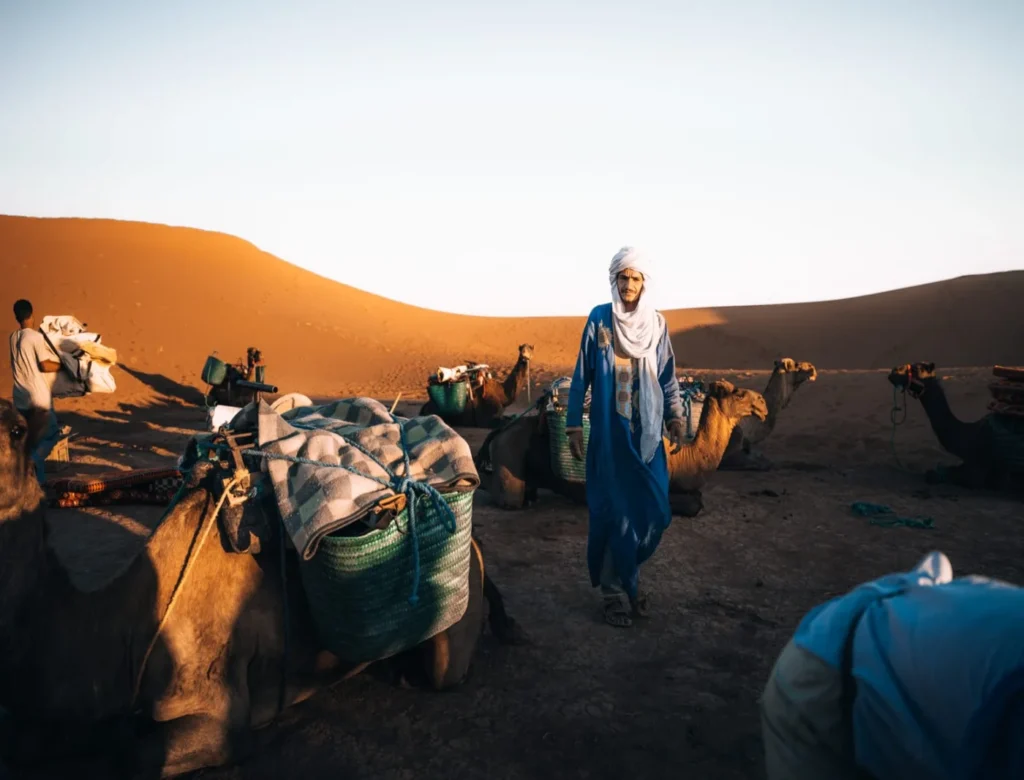
The camels move forward with confidence. Well fed, well watered, treated with respect and gentleness. On the trail, the guides walk beside them — on foot, finding for them the best paths, the gentlest descents. For a Saharan nomad, the animal is a precious companion on the road.
FAQ — Moroccan Sahara Guide
Is It Safe to Travel in the Moroccan Sahara?
Yes — the Moroccan Sahara is one of the safest destinations in Africa. With a native guide who knows the terrain, risks are minimal. The main precaution: never venture alone without a guide into the deep desert. Conditions can change fast — heat, orientation, water sources. With Lahsan, you are in good hands.
Is the Moroccan Sahara Suitable for Solo Female Travellers?
Yes — and it is a priority at ADN Sahara. Circuits are always private, never mixed. Lahsan and his team are deeply respectful — every traveller feels safe, respected, free. Many women travel alone with ADN Sahara every year.
Is the Moroccan Sahara Suitable for Families with Children?
Yes — children love the desert. Children under 12 are free (1 per paying adult). For younger children, 4×4 circuits are better suited than walking treks. From age 10, easy treks are accessible.
What Is the Difference Between a Trek and a 4×4 Circuit?
A trek is done on foot and by camel — total immersion, slow pace, direct contact with the desert. The 4×4 allows covering greater distances, ideal in summer or with limited time. Both offer an authentic nomadic experience — simply two different ways of loving the desert.
What Budget for a Moroccan Sahara Trip?
ADN Sahara treks start from €60 per person per day (1-day trek) — all inclusive, guide, meals, camel. No deposit required — payment on arrival, in euros, dirhams or dollars.
All our prices are fully transparent — no hidden fees, no deposit required. Find the detailed rate tables directly on each trip page:
→ Trek prices — all our Sahara Morocco treks → 4×4 circuit prices — all our Sahara circuits
What Is a Digital Detox Desert Morocco Experience?
We spend fortunes on digital detox retreats and screen-limiting apps. The desert handles it naturally — and for free. Days without notifications, without emails, without digital noise. Just the present, the sand, the sky. Perhaps the real luxury of our era — and Lahsan has offered it since always, without even knowing it.
Our Travel Stories & Desert Journals
Coming soon on this Moroccan Sahara guide:
- Trek diaries — authentic stories from the dunes
- Nomadic traditions — culture, crafts, desert way of life
- Nomadic cuisine — tajines, sand bread, ceremonial tea
- Sahara secrets — what only native guides know
Come back soon — the desert has much to tell. 🐪
Ready to Experience the Desert?
Contact Lahsan — Moroccan Sahara guide based in M’Hamid El Ghizlane. Together, let’s create your tailor-made adventure in the dunes of Erg Chegaga, on the trails of Erg Zahar, or along the sleeping Drâa.
A question? Write to Lahsan on WhatsApp
→ See all our Moroccan Sahara treks → See all our Sahara 4×4 circuits
Last updated: March 2026
Guide created by ADN Sahara — Native nomadic guides — M’Hamid El Ghizlane, Morocco